
 Submit Manuscript
Natural Compounds in Ischemic Stroke Therapy: Mechanisms, Systems Pharmacology, and Targeted Delivery
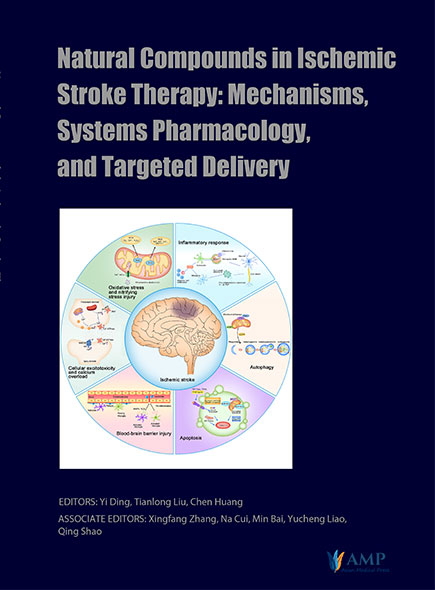
Publisher: Asian Medical Press Ltd; 1st edition (2026)
ISBN-13: 978-1-0687236-1-2
Hardcover: 203 pages
Language: English
Available at: Being Sent to Amazon
Yi Ding1,Tianlong Liu2,Chen Huang3
1. Department of Pharmacy, Xijing Hospital, Fourth Military Medical University, Xi'an 710032, China.
2. Department of Pharmacy, The 940th Hospital Joint Logistics Support Forces of PLA, Lanzhou 730050, China.
3. Department of Plastic and Reconstructive Surgery, Xijing Hospital, Fourth Military Medical University, Xi’an 710032, China.
Xingfang Zhang1, Na Cui2, Min Bai3, Yucheng Liao1, Qing Shao4
1. Department of Pharmacy, Xijing Hospital, Fourth Military Medical University, Xi’an 710032, China.
2. Department of Pharmacy, 3201 Hospital, Hanzhong 723000, China.
3. Department of Geriatrics, Xijing Hospital, Fourth Military Medical University, Xi'an 710032, China.
4. Xi’an Mental Health Center,Xi'an 710100,PR China.
1-22
23-64
65-76
77-90
91-120
121-138
139-150
151-177
Ischemic stroke presents a complex pathophysiology that has hampered the development of effective neuroprotective therapies. In recent years, research has increasingly turned to multi-targeted natural compounds and innovative delivery strategies to address this challenge. This volume, Natural Compounds in Ischemic Stroke Therapy: Mechanisms, Systems Pharmacology, and Targeted Delivery, brings together a series of investigations that collectively outline a pragmatic and promising research pathway from mechanistic understanding to therapeutic application.
The initial chapters establish a foundational understanding of key molecular pathways. The role of PI3K/AKT signaling in neuroprotection is thoroughly examined, providing a critical context for the actions of many therapeutic agents. This is complemented by an exploration of the integrin family as emerging targets in neurological disorders, highlighting their broader significance in central nervous system function and disease.
A significant portion of this work is dedicated to the systematic investigation of specific natural products. The pharmacological profile of Boswellic acids is detailed in terms of their molecular mechanisms and challenges in bioavailability, with a subsequent systematic review providing robust evidence for the neuroprotective efficacy of Boswellia extract across several animal models of neurological disease. This focused analysis is expanded to other botanicals, including salvianolic acids, Choerospondias axillaris, and the formula QiShenYiQi. Employing systems pharmacology and experimental validation, these studies decode the multi-target, synergistic mechanisms by which these compounds exert their effects, predominantly through modulating inflammation and apoptosis.
Building on this, a deeper layer of mechanistic insight is provided by a single-cell transcriptomics study, which reveals the precise cellular subtypes and interactions underlying the synergistic effect of two key boswellic acid constituents, identifying Spp1 as a potential central node.
Finally, the volume addresses a critical translational hurdle: the blood-brain barrier. The concluding chapter presents a practical solution through the development of a peptide-drug conjugate, demonstrating that targeted delivery of a boswellic acid derivative significantly enhances its anti-inflammatory efficacy and therapeutic outcome in an animal model of stroke.
Collectively, the research compiled herein illustrates a coherent and incremental approach to drug discovery. It underscores the value of rigorously investigating natural compounds, employing modern analytical techniques to understand their integrated mechanisms, and engineering smart delivery systems to realize their full clinical potential. We hope this collection provides a useful and grounded resource for researchers in the field.